

PSLE English Composition 2026
A good way to
spend time.
A different kind of topic.
And more story possibilities than you might think.

This year’s PSLE English Composition topic, “A Good Way to Spend Time”, is an interesting one.
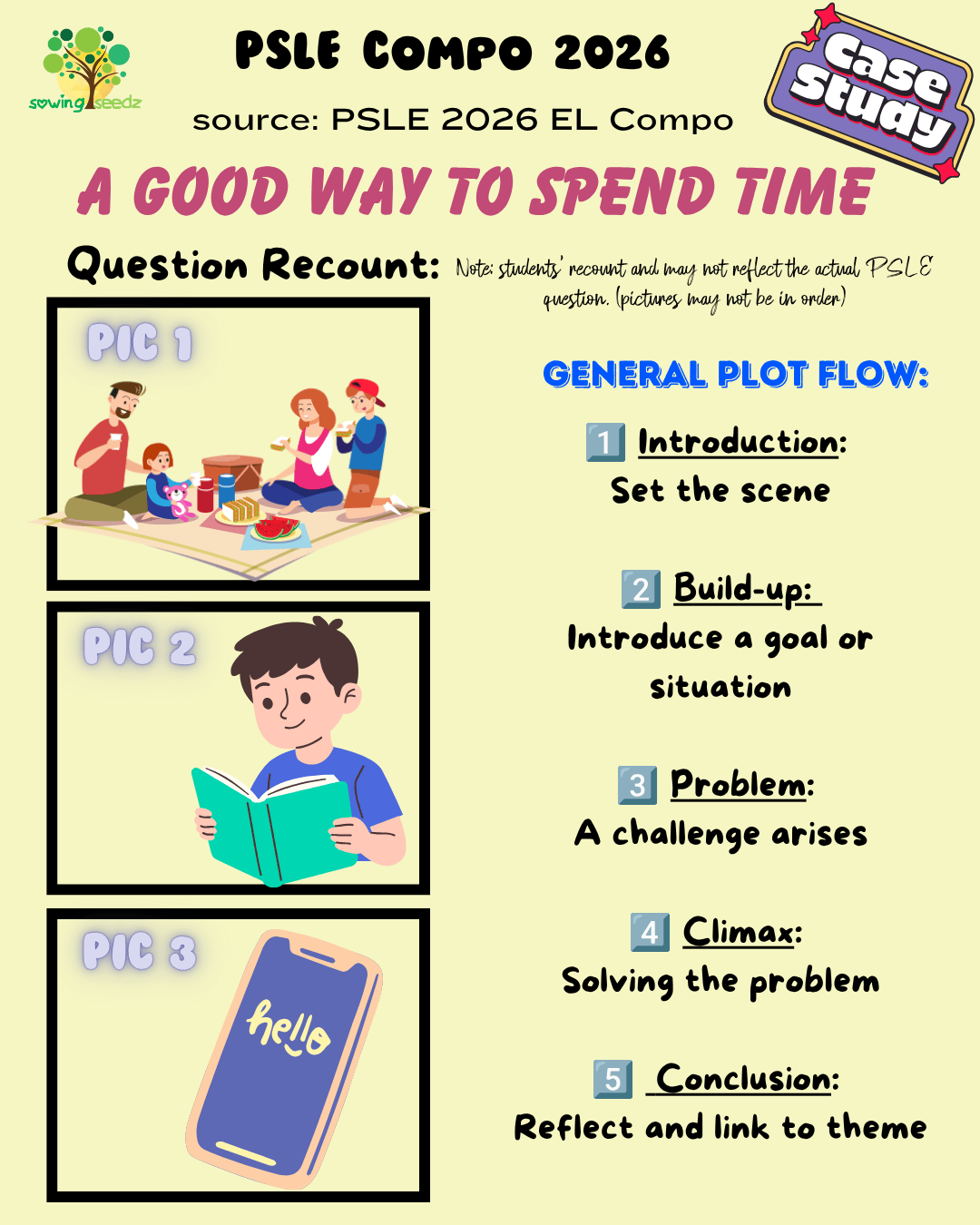
When I first looked at the topic and the three recounted picture cues — family, reading and a phone-related image — I actually needed some time to gather my thoughts too. 😆
At first glance, the pictures seem straightforward. In fact, perhaps too straightforward.
- Family Spend time with family.
- Book Spend time reading.
- Phone Think about how we use our time with technology.
And that is precisely where I feel this year’s topic becomes interesting.
See the recounted picture prompts & general plot flow
Open the full-size graphic ↗
The danger of the
“Dear Diary” story
The title and pictures can easily swing students towards writing a very predictable, recount-style composition:
The easy first idea“Last Sunday, I spent time with my family. We had lunch together. We talked and laughed. I had a wonderful time. I realised that spending time with my family was a good way to spend time.”
Relevant? Yes.
But as a story, there may not be much happening.
Similarly, choosing the book does not mean the composition has to become a description of how much the character enjoys reading. Choosing the phone does not mean writing a general account of playing games or chatting with friends.
Go back to a
familiar framework
This was why, after some brainstorming, I went back to the same framework I have always taught my students.
The topic may look different, but the way we build a story does not suddenly have to change.
- Introduction Set the scene.
- Build-up Introduce a situation or goal.
- Problem Allow a challenge or an unexpected development to arise.
- Climax / Resolution Build towards the climax and resolve the problem.
- Conclusion Reflect and link naturally back to “A Good Way to Spend Time”.
A framework is not there to make every story identical. It gives students a structure to organise their creativity, especially when the question initially leaves them wondering, “What am I supposed to write about this?”
The reluctant
family picnic
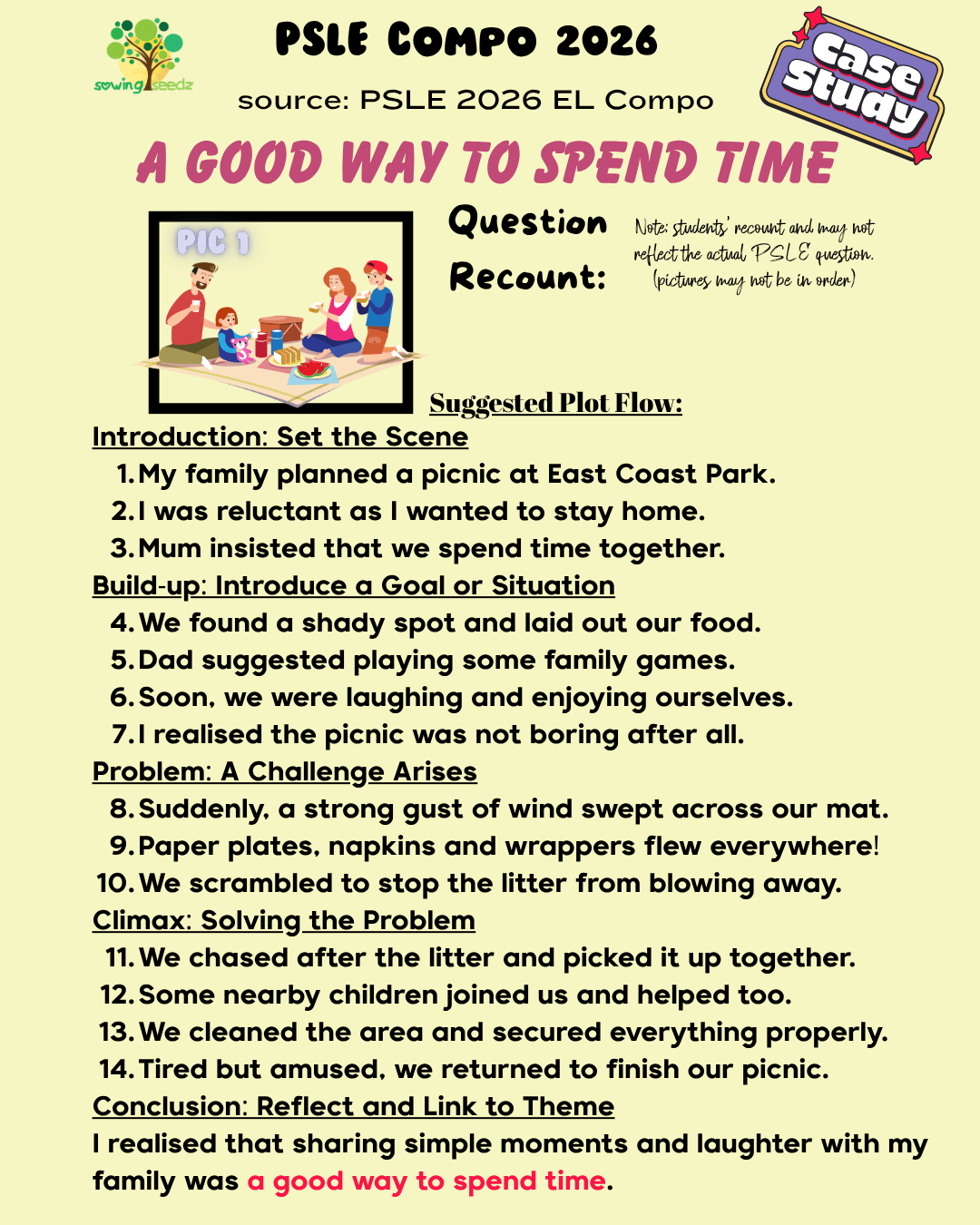
For the family picture, I created a story about a reluctant family picnic. What begins as an outing the narrator does not want to “waste” time on becomes an enjoyable afternoon filled with games and laughter.
When a sudden gust of wind sends their picnic items flying, the family works together to clean up the mess, turning a simple outing into a meaningful way to spend time together.
Open the full-size graphic ↗
A mystery
between the pages
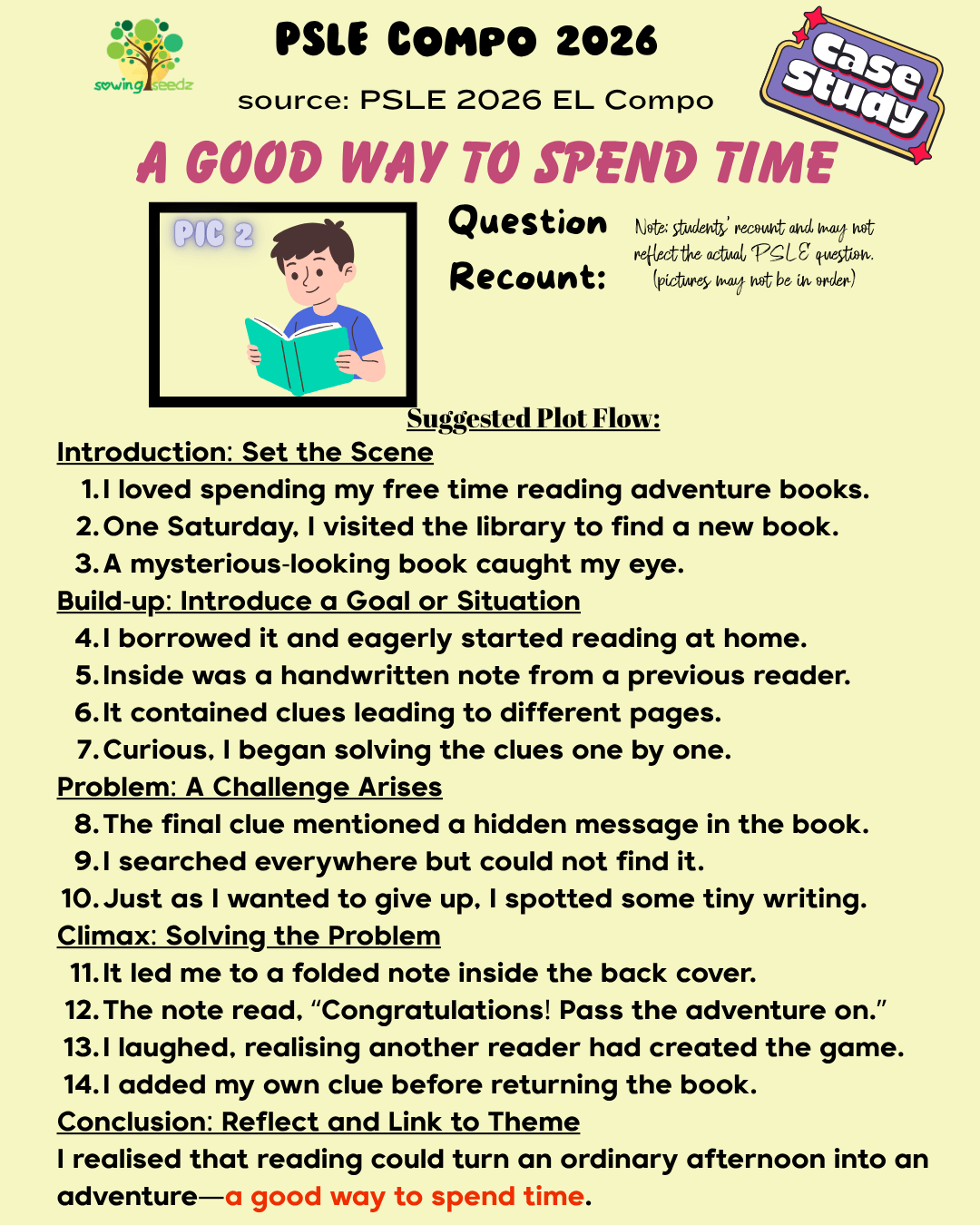
For the book picture, instead of simply writing about enjoying a novel, I turned the book into a mini mystery.
A handwritten note left by a previous reader leads the narrator through a series of clues hidden among the pages. Suddenly, reading becomes an unexpected adventure.
Open the full-size graphic ↗
Putting the
phones away
For the phone-related picture, I explored a family deciding to have a phone-free Sunday. At first, the narrator is reluctant to give up the phone and keeps reaching for it out of habit.
However, the family begins baking together, joking and enjoying one another’s company. When their first cake burns, they decide to try again.
What starts as an unwanted break from technology eventually becomes a meaningful way to spend time together without screens.

Open the full-size graphic ↗
Same title. Three very different stories. And all three can still return naturally to the idea of a good way to spend time.
“Do not allow the picture to limit your story. Let it open the door to one.”
What I hope students take away from composition planning
You do not need the
“perfect” idea immediately
If you looked at this year’s composition question and thought, “Huh? What can I write?” — you probably were not alone. I needed to sit with the topic and brainstorm too.
What matters is knowing how to move forward when the idea does not come immediately.
- Look at the picture.
- Think beyond its most obvious interpretation.
- Create a situation.
- Ask yourself what could happen next.
happen next? What could
go wrong? What could
change?
Then use your familiar framework to shape those ideas into a complete plot. A strong planning structure helps students turn an initially simple idea into a developed narrative rather than merely a sequence of events.
One paper down. Well done. 🧡
Whatever story you wrote is now safely on those pages. No need to replay every sentence in your head or conduct a post-exam investigation with your friends.
Reset, refocus and move towards the next one.
Be ready. Be steady. Be prepared.